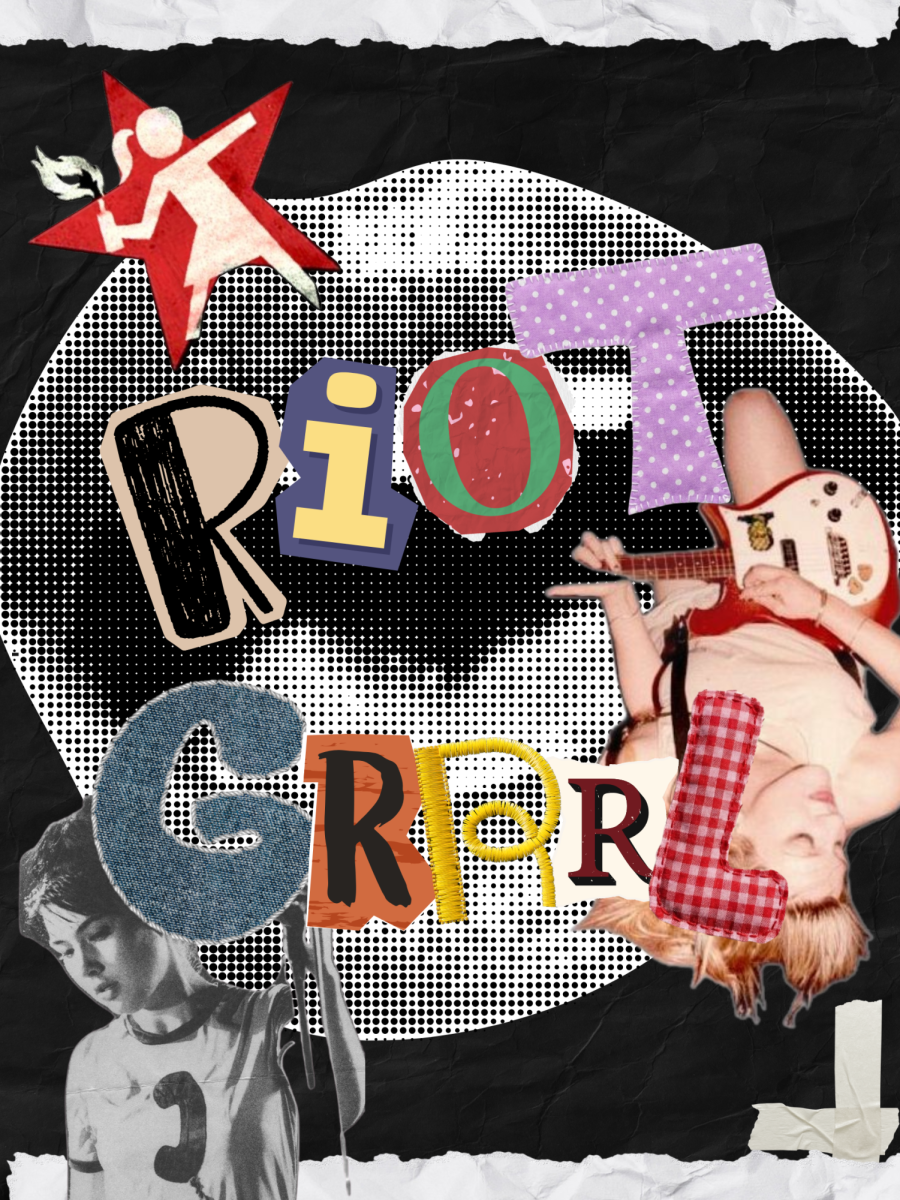
Emerging in the early 1990s alongside bands like Bikini Kill, the Riot Grrrl movement fused punk rock with explicitly feminist politics: lyrics about sexual violence, autonomy, body image, and rage were common themes in songs. It rejected polish and embraced rawness, encouraging girls to form bands regardless of technical skill, to take up space in mosh pits, to speak loudly and imperfectly. Artists adjacent to or shaped by the same energy, from Courtney Love to Jack Off Jill, pushed a version of feminism that was messy, contradictory, and often intentionally abrasive.
Few figures embodied that disruption and the backlash against it more than Courtney Love. Through the 1990s and early 2000s, coverage of Love often focused less on her songwriting or leadership of Hole and more on her behavior, appearance, and personal life. Interviews framed her as volatile, manipulative, or unstable, narratives that hardened after the death of Kurt Cobain, when she became both a tabloid fixture and a target of conspiracy culture. Headlines obsessed over her motherhood, her addiction, her anger; traits frequently mythologized in male rock stars (ironically, as in her husband, Kurt Cobain), but treated as disqualifying in her. Love was rarely allowed to be complicated; she was cast as a media spectacle. The media’s fixation on her chaos overshadowed her role as a frontwoman who wrote about exploitation, girlhood, and power with unusual bluntness. Her aggression, central to her artistic identity, became evidence against her credibility rather than part of it.
That pattern extends beyond one artist. Women in rock, politics, entertainment, and public life more broadly are often framed through personality before substance. Anger becomes hysteria. Ambition becomes calculation. Messiness becomes moral failure. Even in these alternative communities, women who actually live an alternative lifestyle are shamed and mocked, unlike their male counterparts. Riot Grrrl tried to preempt that framing by embracing ugliness and contradiction outright, provoking critics to react. But the response often proved the point: coverage gravitated toward ugliness and scandal, not message. The same dynamic persists today, when women who speak bluntly are labeled divisive, while softer expressions of empowerment are rewarded with visibility and sponsorship. The acceptable version of rebellion is often the one least likely to disrupt.
The political climate in the United States reflects that tension. Debates over reproductive rights, workplace equity, and gender identity dominate public discourse, yet women who lead those conversations are frequently scrutinized for tone, likability, and presentation. The argument shifts from what is being said to how it is said. Riot Grrrl resisted that shift; it insisted that anger itself was political. Courtney Love’s treatment by the media demonstrated the cost of that insistence. Her sharpness, contradictions, and volatility, the very qualities that fueled her art, became reasons to dismiss her and mock her.
In a sense, Riot Grrrl has become domesticated, not eradicated. The aesthetics remain, but the appetite for confrontation has narrowed. The United States is again in a moment of polarization and cultural conflict, the kind that once fueled basement shows and stapled manifestos. But now, the risk isn’t just boos from a crowd or a harsh review in a TMZ magazine; it’s permanence. Social media turns every outburst into a searchable identity, every questionable opinion into a screenshot, every contradiction into evidence. Where Riot Grrrl thrived on ugliness and volatility, today’s artists and audiences alike are trained to anticipate backlash before they even speak. Anger doesn’t just get criticized; it gets archived, dissected, and redistributed.
Layered onto that hesitation is the growth of online subcultures built around resentment toward feminism and women’s autonomy. “Incel,” short for “involuntary celibate,” began as a loose label for young men struggling with loneliness, but it evolved in many online spaces into an ideology that frames women as gatekeepers of status and sex, and feminism as the reason men feel excluded and rejected. These communities often overlap with “red pill” rhetoric, a reference drawn from The Matrix that claims to reveal a hidden truth about gender: that society privileges women, that men are oppressed by modern feminism, and that conservative hierarchies should be restored. Within those frameworks, outspoken or politically enraged women are cast not just as disagreeable but as responsible for social decline.
At the same time, the rise of the “trad wife” aesthetic, romanticizing domestic submission, apolitical femininity, and deference to male authority, offers the inverse ideal. Where incel and red pill rhetoric punishes women for being loud, the trad-wife trend rewards quietness, softness, and withdrawal from confrontation. Both narratives, despite coming from different angles, narrow the acceptable range of female expression. Anger becomes unattractive or unfeminine. Political rage, once central to Riot Grrrl’s ethos, is reframed as something to avoid and is socially unwelcome.
That pressure has reshaped our behavior. To be loud now is to risk social isolation, doxxing, or being reduced to a single clip divorced from context. The result is a quieter rebellion, safer slogans, curated outrage, politics that fit into captions and Instagram bios. But Riot Grrrl was built on the opposite instinct: say it badly, say it loudly, say it before you’re ready, before anyone is ready. The movement assumed confrontation would be controversial and public; today, that messiness feels both unprofessional and dangerous. The question isn’t whether Riot Grrrl is dead; many tune into the genre daily. It’s whether anyone still wants the backlash that comes with it, the kind that turned Courtney Love into a media monster, and turned angry commentary into something women were expected to apologize for.